


The Castello Sforzesco is one of the landmarks of Milan, is located in the historic center and is surrounded by Parco Sempione which extends over 47 hectares of land. The Sforzesco Castle is one of the most important places in Milan, it was built by Francesco Sforza in the fifteenth century and is a work by Antonio Averlino (called Il Filarete) who got to Milan from Florence to lead the works.
Address Piazza Castello – 20121 Milano
Admission Ticket and Opening Times
The visit to the courtyards of the Castello Sforzesco is free. There is an entrance ticket for the Castle Museums.
winter time: 07: 00-18: 00; summer time: 07: 00-19: 00
***

Subsequently Ludovico il Moro took care of making the Castello Sforzesco even more beautiful thanks to the frescoes by Bramante and Leonardo da Vinci, which can still be admired today in the marvelous Sala delle Asse.

In the 16th century, under the Spanish dominion, the Sforza Castle became a military citadel and remained so even under the Habsburg and Napoleonic rule. Napoleon ordered its destruction but fortunately it was never completed.
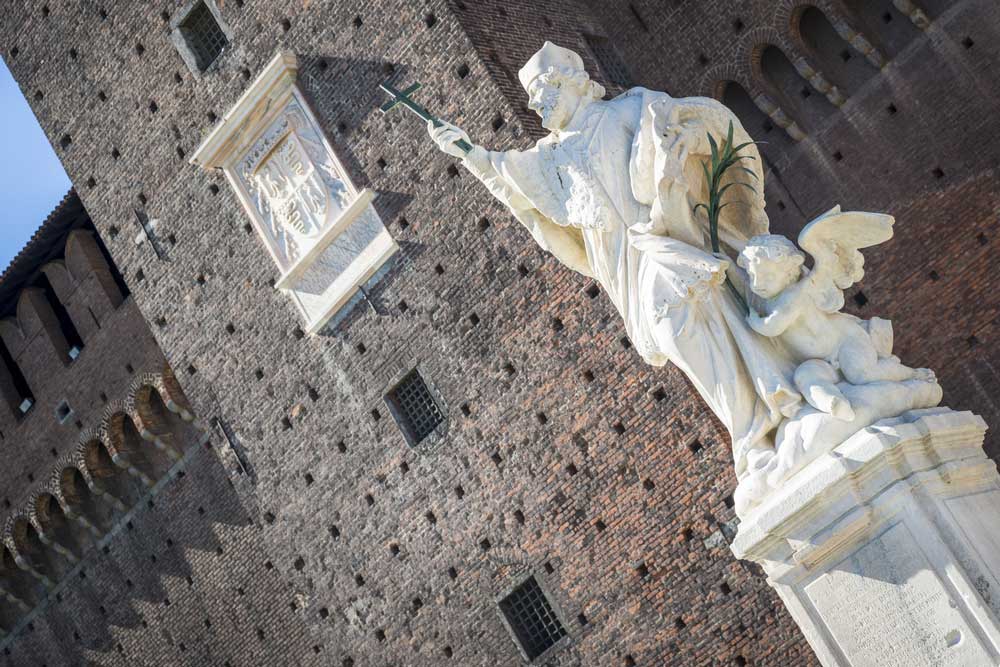
Despite some significant losses, at the beginning of the twentieth century the Castle was completely restored thanks to the architect Luca Beltrami who gave the city of Milan a very faithful work to the original, the result of study, knowledge and great sensitivity. Castello Sforzesco belongs to the City of Milan and is home to the most important museums of the city: Pinacoteca, Egyptian Museum, Museum of Ancient Art, Museum of Musical Instruments, Library of Art, Historical Archive and Library Trivulziana, Collection of Prints Bertarelli . Occasionally, photographic exhibitions of international importance are exhibited at the Castello Sforzesco.
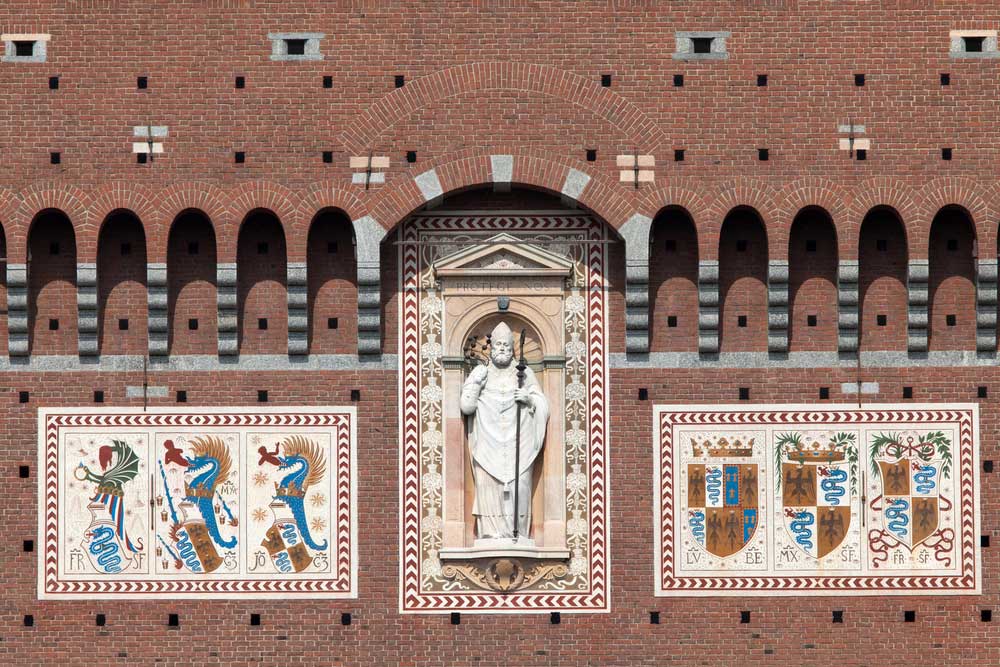
The Sforza Castle Museums
Inside the Castle. Open 9 a.m. to 5.30 p.m. Tuesday to Sunday. Last admission at 5 p.m. Closed on Mondays, 25 December, 1 January and 1 May.
Full price ticket 5 euro, reduced 3 euro. Buy a digital audio guide here, entrance included. The Castle museums are included in the Tourist Museum Card, which is valid for 3 days and costs 12.00 euro, and in the Musei Lombardia Milano card, which is valid for one year and costs 45.00 euro.
The Castello Sforzesco houses a number of museums with important works, such as Michelangelo Buonarroti’s Pietà Rondanini. They range from art to more specialised subjects, such as decorative arts or musical instruments.
Pinacoteca del Castello: includes 1,500 paintings by the most significant painters ranging from the splendours of the Visconti and Sforza courts to works by Foppa, Bergognone, Bramantino, Andrea Mantegna, Antonello da Messina, Daniele Crespi, Carlo Francesco Nuvolone, Sebastiano Ricci, Canaletto, Gianbattista Tiepolo, Francesco Guardi and Bernardo Bellotto.
Pietà Rondanini Museum: housed in the former Castle Hospital, here we find Michelangelo’s last masterpiece, the Pietà Rondanini. This unfinished work, made when the artist was an old man, encapsulates the essence of human love from a single block of marble. Michelangelo sculpted the figures of Christ and the Virgin fused in a single embrace.
Museum of Decorative Arts: an exhibition of 1,300 objets d’art in ivory, metal, glass, ceramics, textiles, ranging from the early Middle Ages to the Contemporary Age.
Museum of Musical Instruments: a collection of objects donated by the Monzino family, a historic Milanese factory specialising in musical instruments. In addition to these prestigious gifts, there is a collection of string, plucked and wind instruments dating from the Renaissance to the 20th century. The museum is completed by a collection of musical instruments from various parts of the world.
Museum of Prehistory and Protohistory: an exhibition of objects and materials that reconstruct and tell the story of human life in northern Italy from the Neolithic to the 2nd and 1st centuries BC. C.
Egyptian Museum: a collection of objects that tell the story of Egyptian culture, relics, papyri and decorated wood, divinities, vases, funerary statuettes, amulets, painted sarcophagi and even a mummy from the 7th century B.C. Museum of Ancient Art: a collection of 400 sculptural works that tell the story of Lombardy, from the Middle Ages to the Renaissance.